
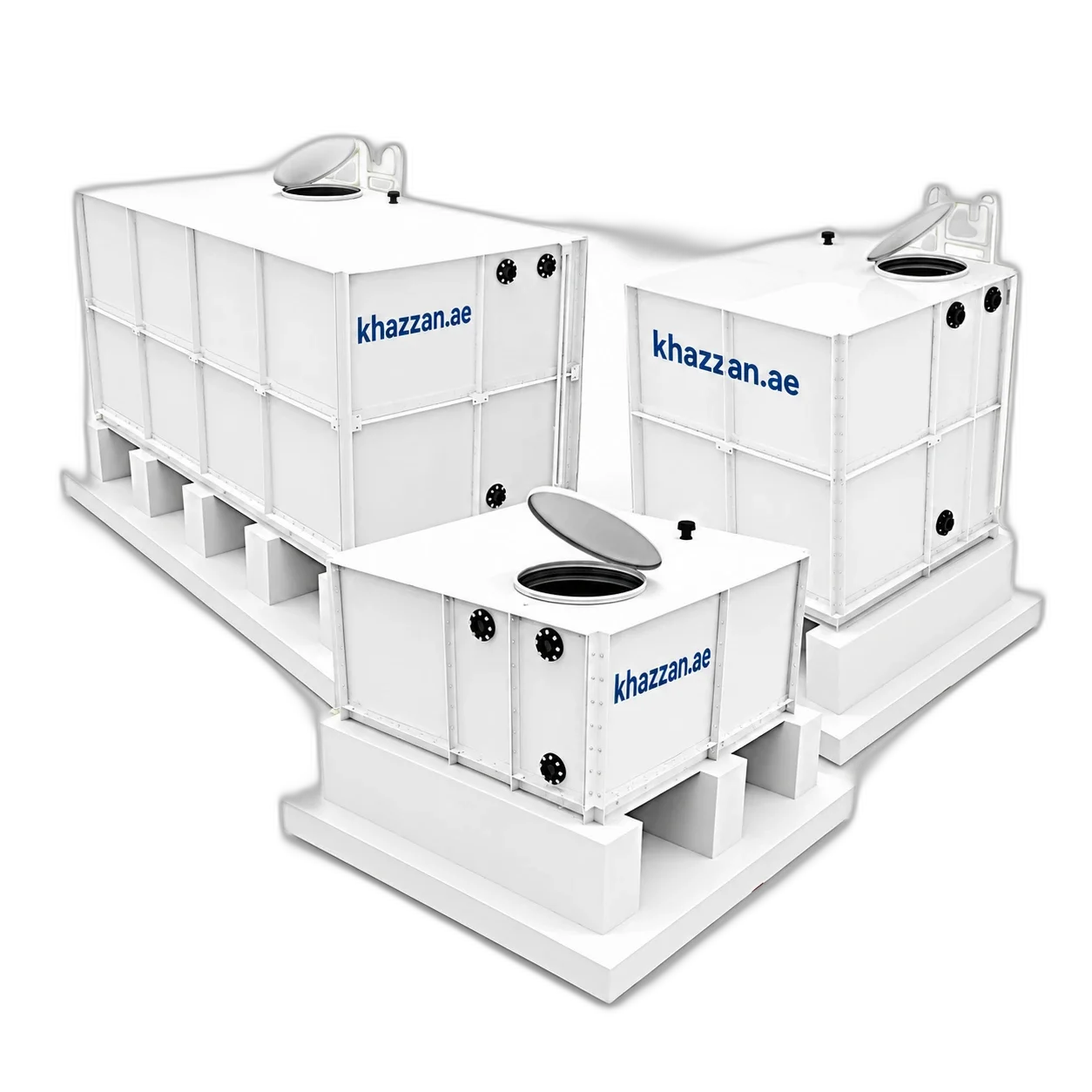
Sectional GRP Panel Tanks UAE: How They Work and When to Use Them
Quick answer: Sectional GRP panel tanks, also called hot press panel tanks, are built from bolted Sheet Moulding Compound panels assembled on-site rather than delivered as one finished piece, letting them reach capacities from 1,000 USG up to 100,000 USG and beyond in basement plant rooms, rooftops, and other locations a factory-built single-piece GRP tank cannot physically access.
Sectional GRP panel tanks, also called hot press panel tanks, are a modular alternative to single-piece GRP or polyethylene tanks, built by assembling individual panels on-site rather than delivering one finished tank. This construction method solves a specific problem in the UAE market: how to install very large capacity storage in locations a factory-built tank simply cannot reach. This guide explains how panel tanks are built, when they make sense over a single-piece tank, and what to check before specifying one.
Key Takeaways
- Panel tanks are assembled on-site from bolted SMC panels rather than delivered as one finished piece.
- They solve access problems in basements, high-rise plant rooms, and sites with no crane access.
- Capacities commonly range from 1,000 USG to 100,000 USG and beyond, larger than practical single-piece GRP.
- Panel tanks have the same corrosion resistance and UV performance as single-piece GRP when properly installed.
- Pricing is quoted per project after a site assessment due to structural frame and installation variables.
What a Sectional Panel Tank Is
Sectional panel tanks are built from Sheet Moulding Compound (SMC) panels, produced by hot pressing pre-mixed glass fibre and resin in hydraulic moulds at the factory. Each panel is a flat or curved GRP section with bolt holes along its edges. On-site, technicians bolt the panels together, using internal gaskets and sealant at each joint, to build up a complete tank of the required size, typically supported internally by a steel or GRP structural frame for larger installations that helps the assembled panel walls resist the hydrostatic pressure of the stored water.
Because the tank arrives as a stack of flat panels rather than one large moulded shape, it can be transported through standard doorways, lift shafts, and site access routes that would never accommodate a single-piece tank of the same final capacity. A 20,000 USG panel tank, for example, might be delivered as a pallet of individual panels each small enough for two technicians to carry, rather than as one enormous moulded shell requiring a crane and a clear overhead route to the installation point.
How Panel Tanks Are Installed
Installation begins with laying out and levelling the base, often a concrete plinth or steel base frame designed to the tank manufacturer's specification. Panels are then bolted together progressively, building up the tank walls course by course, with a butyl or EPDM gasket compressed at each joint to create a watertight seal. For larger tanks, an internal or external structural frame is fitted to brace the panel walls against the pressure of the filled tank. Once assembly is complete, the tank is pressure-tested by filling it with water and inspecting every joint for leaks before it is signed off and connected to the property's plumbing system.
Why UAE Buyers Choose Panel Tanks Over Single-Piece GRP
The primary reason is access. Basement plant rooms, rooftop locations reached only by narrow stairwells, and sites with no crane access for a large single-piece tank are common in UAE high-rise and dense urban developments. Panel tanks solve this by being assembled in place rather than delivered whole, removing the transport and crane constraints that would otherwise cap the achievable capacity at a given site.
Panel tanks also scale to very large capacities more practically than single-piece tanks. UAE panel tank systems commonly range from 1,000 USG up to 100,000 USG and beyond, built from a standard panel module repeated as many times as needed for the required footprint and height. This modularity means the same panel product line can serve a small commercial rooftop installation and a very large industrial reservoir, simply by varying the number of panels used.
Panel construction also allows future capacity expansion in some cases, since additional panel sections can potentially be added if the installation was designed with future expansion in mind, though this requires planning at the original design stage, including leaving adequate structural frame capacity and site space for the eventual expansion.
Applications for Panel Tanks in UAE
Panel tanks are widely used in high-rise residential and commercial towers where the water tank is located in a basement or rooftop plant room with restricted access, large labour camps and industrial facilities needing very high total capacity across a compact footprint, and infrastructure projects such as pump stations and utility reservoirs where a large single volume is required at a fixed location. They are also common in phased developments, where a panel tank's modularity allows capacity to be matched more closely to a project's build-out stage than a fixed single-piece tank would allow.
Panel Tank Sizes and Pricing in UAE
| Capacity | Typical Use Case |
|---|---|
| 1,000 – 2,000 USG | Small commercial rooftop or plant room |
| 5,000 – 10,000 USG | Mid-size commercial buildings, hotels |
| 20,000 – 50,000 USG | Large residential towers, labour camps |
| 100,000 USG+ | Industrial facilities, utility reservoirs |
Panel tank pricing depends heavily on total capacity, the structural support frame required, and site-specific installation complexity, and is typically quoted per project after a site assessment rather than as a fixed catalogue price. Factors that influence the final quote include the number of panels required, whether an internal or external structural frame is specified, access conditions for bringing panels to the installation point, and whether the site requires out-of-hours installation to avoid disrupting an operational building.
Panel Tanks vs Single-Piece GRP: When to Choose Which
Choose a single-piece GRP tank when the installation location has clear crane or forklift access and the required capacity is within the practical range for factory-built delivery, typically up to around 20,000 USG for horizontal tanks. Single-piece tanks are generally faster to install since there is no on-site assembly, and have fewer joints that could theoretically develop a leak over time.
Choose a panel tank when the installation location cannot be reached by a factory-built tank due to access constraints, when the required capacity exceeds what is practical to transport and crane into position as one piece, or when the project may need future capacity expansion that a fixed single-piece tank could not accommodate.
What to Check Before Specifying a Panel Tank
Confirm the panel manufacturer's UAE Municipality Certification covers the specific panel system and joint sealing method being proposed, not just GRP tanks in general, since certification is tied to the specific product and construction method. Ask whether the structural support frame is included in the quotation or must be procured separately, as this can be a significant cost component easily missed when comparing quotes. For sites with restricted access, confirm the panel dimensions will actually fit through the access route before finalising the specification, since even panel systems have size and weight limits per section that need to clear doorways, stairwells, or lift capacities. Finally, ask about the pressure-testing procedure used to verify the assembled tank is watertight before handover, and request the test documentation as part of the project record.
Maintenance and Inspection of Panel Tanks
Panel tanks require the same routine cleaning and disinfection schedule as any other water storage tank, typically annually for standard properties and twice yearly for high-occupancy or sensitive-use sites. In addition to standard cleaning, panel tanks benefit from a periodic visual inspection of the internal joint lines and bolted connections, ideally carried out during the same visit as routine cleaning, to catch early-stage gasket wear or bolt loosening before it develops into a leak.
For large panel tank installations supporting critical facilities, some property managers schedule an annual structural inspection of the support frame in addition to the water-side cleaning inspection, particularly for tanks that have been in service for over a decade, to confirm the frame and panel assembly remain in good structural condition.
Because a panel tank has more individual joints than a single-piece tank, a slightly more attentive inspection routine on those joints is a sensible trade-off for the access and capacity flexibility panel construction provides. In practice, well-installed panel tanks with correctly specified gaskets and proper bolt torque have a comparable maintenance burden to single-piece GRP tanks over their service life.
Frequently Asked Questions
Q: What is the difference between a sectional panel tank and a regular GRP tank? A: A regular GRP tank is manufactured as one complete piece at the factory and delivered whole. A sectional panel tank is built from individual bolted panels assembled on-site, allowing it to fit through access routes and reach capacities a single-piece tank could not.
Q: Can panel tanks reach the same capacity as single-piece GRP tanks? A: Panel tanks generally scale to larger capacities than single-piece tanks, commonly up to 100,000 USG and beyond, since capacity is built up by adding more panel modules rather than being limited by transport and crane constraints.
Q: Are panel tanks as durable as single-piece GRP tanks? A: Yes, when properly installed with correctly sealed joints and an adequate structural support frame. The panel material itself has the same corrosion resistance and UV performance as single-piece GRP.
Q: When should I choose a panel tank instead of a single-piece tank? A: When the installation location cannot be reached by a factory-built single-piece tank due to access constraints, or when the required capacity exceeds what is practical to transport and crane into position as one piece.
Q: How are panel tank joints sealed to prevent leaks? A: Each panel joint uses a compressed butyl or EPDM gasket to create a watertight seal. The fully assembled tank is pressure-tested by filling it with water and inspecting every joint before handover.
Q: Can a panel tank be expanded later if more capacity is needed? A: In some cases, yes, if the original installation was designed with future expansion in mind, including adequate structural frame capacity and site space. This needs to be planned at the initial design stage rather than added as an afterthought.
Q: How is panel tank pricing different from standard catalogue GRP tank pricing? A: Panel tank pricing depends on total capacity, the structural frame required, and site-specific installation complexity, so it is typically quoted per project after a site assessment rather than published as a fixed catalogue price like standard single-piece tanks.
Q: What is a GRP panel? A: A GRP panel is a flat section of glass-reinforced plastic, made by hot pressing glass fibre and resin (SMC) in a mould. Panels are bolted together with gaskets and sealant to form a complete tank.
Q: What is the difference between FRP and GRP tanks? A: FRP means fibre-reinforced plastic, a broader term that can include carbon or other fibres. GRP means glass-reinforced plastic. For water tanks the two terms are used interchangeably, since both describe a glass-fibre composite tank.
Q: What is the cost of a GRP tank? A: Single-piece GRP tanks range from about AED 1,000 for a 300 USG tank to AED 50,000 or more for a 20,000 USG tank. Panel tanks are quoted per project. See our GRP tank price guide.
Q: Do GRP panel tanks prevent algae growth? A: Opaque panels block sunlight, which limits algae growth inside the tank. Regular cleaning is still needed, at least once a year for potable water tanks.
Q: How do I work out the capacity and panel count of a panel tank? A: Panels are typically 1 m x 1 m, so capacity is length x width x height in metres, multiplied by 1,000 litres. See our GRP panel tank size chart for capacities, US Gallon equivalents, and panel counts.
KHAZAAN supplies hot press SMC panel tank systems from 1,000 USG to 100,000 USG for UAE commercial, residential, and industrial projects with restricted-access installation requirements. Contact KHAZAAN on WhatsApp +971509583173 or visit khazaan.ae for a site assessment.