
Commercial and Industrial Water Tanks in UAE: A Buyer's Guide
Quick answer: Commercial and industrial water storage in the UAE is typically GRP fiberglass above roughly 3,000 USG, sized on daily per-occupant consumption figures (30–50 L/person for offices, 200–400 L/room for hotels, 100–150 L/person for labour camps) with at least one day of reserve capacity, procured through written UAE Municipality Certified specifications and multiple competitive quotations.
Commercial and industrial properties in the UAE, from hotels and hospitals to factories and labour camps, have water storage requirements that differ significantly from residential villas. Larger capacities, higher reliability demands, and procurement processes involving multiple stakeholders all shape how commercial buyers should approach a water tank purchase. This guide covers sector-specific requirements, sizing methodology, material selection, and procurement best practice for commercial and industrial buyers.
Key Takeaways
- GRP fiberglass is the standard material for commercial and industrial storage above roughly 3,000 USG.
- Sizing is based on daily per-occupant consumption multiplied by occupancy, with at least one day of reserve.
- Hotels and larger buildings often need a separate dedicated fire suppression reserve tank.
- Commercial buyers should always request UAE Municipality Certification and ISO 9001:2015 documentation.
- Storage is often split across multiple tanks for redundancy and space constraints rather than one large tank.
How Commercial Requirements Differ from Residential
Commercial and industrial properties typically need capacities well beyond what polyethylene tanks can provide, pushing most projects toward GRP fiberglass or hot press panel tank systems. Reliability matters more, since a storage failure can affect dozens or hundreds of occupants or interrupt an operational process, whereas a residential tank issue affects a single household. Procurement is also more formal, usually involving written specifications, multiple competitive quotations, and documentation requirements that residential purchases rarely need, including compliance sign-off from consultants or facilities management teams.
Typical Commercial and Industrial Sectors and Their Needs
Hotels and resorts require large-capacity storage for guest water demand plus a dedicated fire suppression reserve, often specified separately from domestic supply and sized according to local fire code requirements rather than occupant water use.
Hospitals and healthcare facilities need high-purity storage with smooth, easily disinfected internal surfaces and strict compliance documentation, since water quality failures in a healthcare setting carry significant regulatory and patient safety consequences.
Factories and industrial facilities need process water, cooling tower makeup water, and in many cases wastewater holding tanks in appropriate resin specifications, since some industrial liquids require vinyl ester rather than standard polyester resin for adequate chemical resistance.
Labour camps require large total storage volume calculated against UAE Labour Camp Regulations for occupancy-based water provision, and typically use multiple large GRP horizontal tanks to reach the required total capacity within available site footprint.
Shopping malls and apartment towers need central water storage sized for peak demand across large numbers of units or visitors, often using basement or rooftop panel tank systems where a single-piece tank cannot be transported to the installation point.
Educational facilities such as schools and universities have highly variable daily demand tied to term-time occupancy, requiring careful sizing to avoid excessive water age (and associated quality degradation) during low-occupancy periods like summer break.
Sizing Commercial and Industrial Tanks
Commercial sizing starts from daily consumption figures specific to the property type. Office buildings typically use 30 to 50 litres per person per working day. Hotels use 200 to 400 litres per occupied room per day depending on facilities such as spas or pools. Labour camps use 100 to 150 litres per resident per day for basic facilities. Hospitals typically require substantially higher per-bed consumption figures due to clinical and sanitation demands, and should always be sized in consultation with an MEP engineer familiar with healthcare-specific standards.
The tank capacity should cover at least one day of demand as a baseline, with two to three days recommended where mains supply interruptions are a realistic operational risk, such as properties in areas with a documented history of supply disruption or facilities where any water interruption has serious operational consequences.
For large properties, storage is often split across multiple tanks rather than a single very large tank, both for redundancy (allowing one tank to be taken offline for cleaning without losing supply) and to fit available space constraints on rooftops or in plant rooms. This approach also limits the operational impact of any single tank failure to a fraction of total site capacity rather than the whole system.
Material Choice for Commercial and Industrial Applications
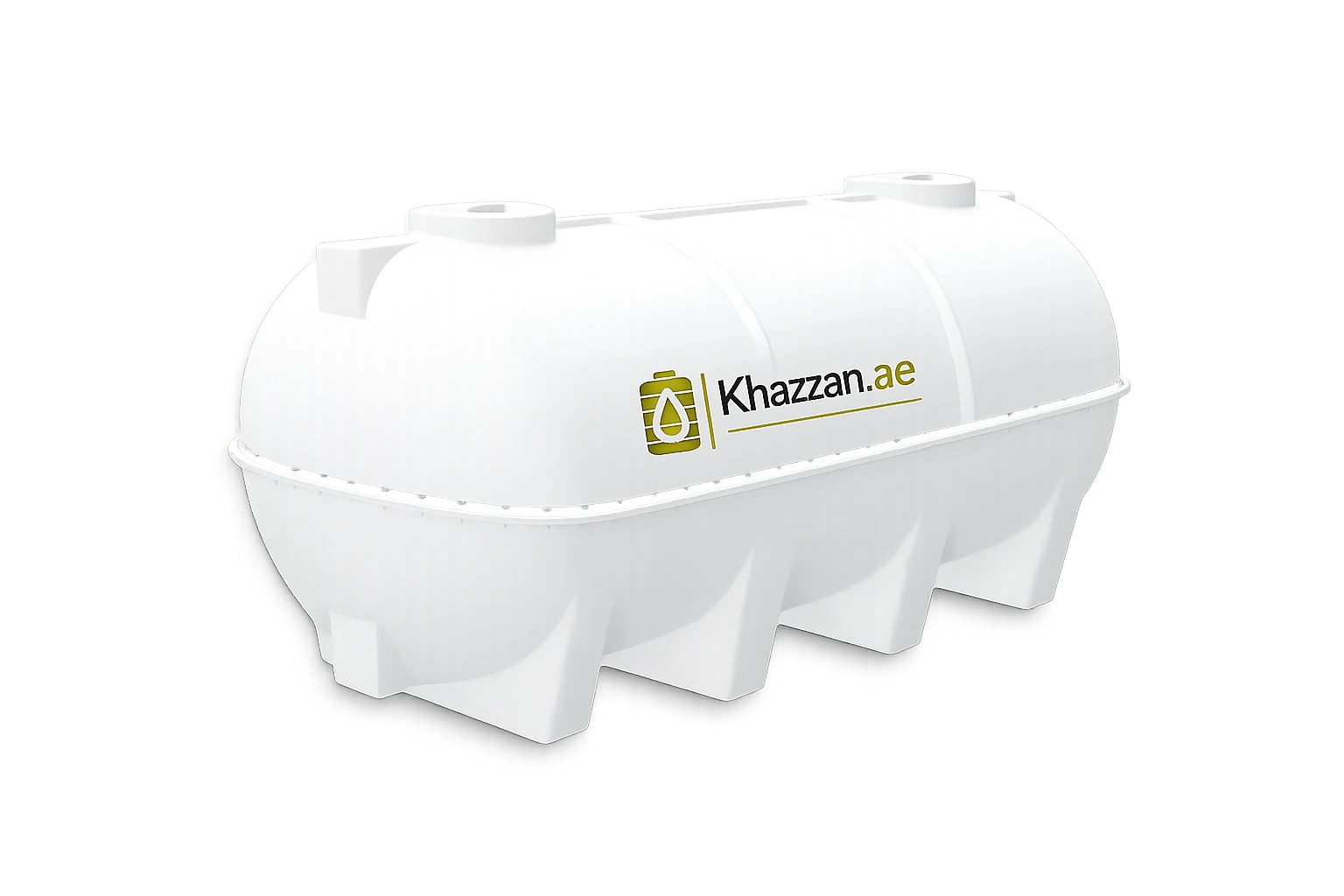
GRP fiberglass is the standard material for commercial and industrial storage above roughly 3,000 USG, offering the structural capacity, chemical resistance, and 20 to 25 year design life that large installations require. Polyester resin is standard for potable water; vinyl ester is specified where enhanced chemical resistance is needed for industrial or wastewater applications.
For sites where a factory-built tank cannot be transported or craned into position, hot press SMC panel tank systems provide a modular alternative, assembled from individual panels on-site to reach very large capacities in constrained locations such as basement plant rooms or high-rise rooftops reached only by narrow access routes.
Procurement Considerations for Commercial Buyers
Commercial and industrial buyers should request UAE Municipality Certification and ISO 9001:2015 documentation for any supplier under consideration, obtain at least two to three competitive written quotations covering tank, delivery, and installation as separate line items, and confirm warranty terms and the supplier's ability to provide after-sales support at the scale the project requires, including response time commitments for any warranty claim.
For large projects, a factory audit or third-party inspection before delivery is common practice to verify manufacturing quality on custom or high-value orders. This is particularly important for panel tank systems and custom-dimension GRP tanks, where manufacturing quality has a wider tolerance for variation than standard catalogue sizes.
Compliance and Documentation Checklist
Before finalising a commercial or industrial water tank purchase, confirm the supplier can provide: a current UAE Municipality Certificate naming the specific tank model and capacity; ISO 9001:2015 certification for the manufacturing facility; material data sheets confirming resin type and food-grade compliance where applicable; a written warranty document specifying duration and claims process; and, for fire suppression reserve tanks, documentation confirming the tank meets the relevant fire code capacity and construction requirements specified by the project's fire consultant.
Total Cost of Ownership for Commercial Buyers
Commercial and industrial buyers evaluating tank options should look beyond the initial purchase price to the full cost of ownership across the tank's service life, since the cheapest quote on paper is not always the lowest total cost.
Maintenance frequency and cost. Larger and more complex installations, particularly multi-tank sites, benefit from negotiating an annual maintenance contract covering all tanks on site rather than booking each cleaning separately, which typically reduces the per-visit cost meaningfully compared to ad hoc bookings.
Downtime cost. For operationally critical facilities such as hospitals, factories, or hotels, the cost of a water supply interruption during tank maintenance or an unexpected failure can far exceed the tank's purchase price in lost operations or guest experience. This is a strong argument for redundant multi-tank configurations even where a single large tank would technically meet the calculated capacity requirement.
Warranty and service response. A supplier's warranty terms matter less than their actual ability to respond quickly to a claim. For commercial buyers, asking for a specific response time commitment in writing, and checking references from other commercial clients about real-world response times, is more informative than the warranty duration alone.
Scalability. Properties expecting future capacity growth, whether through phased construction or increasing occupancy, benefit from specifying a system (particularly panel tanks) that can accommodate future expansion without a full system replacement, even if this means a modest additional upfront cost for future-proofing.
Factoring these considerations into the initial procurement decision, rather than focusing solely on the lowest tank price, typically produces a better outcome over the project's full operational life.
Working with Consultants and Facilities Management Teams
Larger commercial and industrial water tank projects in the UAE typically involve an MEP consultant at the design stage and a facilities management team responsible for the property once it is operational, and aligning these two groups early avoids costly rework later. The consultant's specification should reflect not just the calculated capacity but also practical facilities management considerations: access for future cleaning and maintenance, isolation valve placement that allows individual tanks to be serviced without shutting down the whole system, and clear labelling of tank capacities and connections for the operational team who will manage the system for years after the original project team has moved on.
Facilities management teams should be involved in reviewing the tank specification before procurement is finalised, since they are best placed to flag practical concerns the original design might miss, such as whether the chosen access cover size and location will actually be usable for the cleaning contractor's equipment, or whether the tank room has adequate drainage for a full tank drain-down during cleaning. Involving this perspective early is far cheaper than discovering an operational limitation after the tanks are installed and commissioned.
Frequently Asked Questions
Q: What tank material is best for commercial and industrial use in UAE? A: GRP fiberglass is the standard choice above roughly 3,000 USG due to its structural capacity and long service life. For very large or hard-to-access sites, hot press panel tank systems offer a modular alternative.
Q: How is commercial water tank capacity calculated? A: Capacity is based on daily consumption figures specific to the property type (offices, hotels, labour camps, etc.) multiplied by occupancy, with at least one day of reserve storage built in, often two to three days for properties where supply interruptions are a concern.
Q: Do commercial water tanks need separate fire suppression storage? A: Many commercial properties, particularly hotels and larger buildings, specify a dedicated fire suppression reserve tank separate from domestic water storage, based on local fire code and insurance requirements.
Q: What documentation should a commercial supplier provide? A: UAE Municipality Certification for the specific tank model, ISO 9001:2015 certification for the manufacturing facility, and a written quotation clearly itemising tank, delivery, and installation costs.
Q: Why do commercial properties use multiple smaller tanks instead of one large tank? A: Splitting storage across multiple tanks allows one to be taken offline for cleaning or maintenance without losing supply, limits the impact of any single tank failure, and often fits available rooftop or plant room space better than one very large tank.
Q: How long does a commercial GRP tank last in UAE conditions? A: A properly specified and maintained commercial GRP tank has a design life of 20 to 25 years in UAE conditions, longer than the 10 to 15 year typical service life of polyethylene tanks.
Q: Should hospitals use a different tank specification than a standard commercial building? A: Yes. Healthcare facilities typically require higher per-bed consumption sizing, stricter documentation, and smooth, easily disinfected internal surfaces, and should always be specified in consultation with an MEP engineer experienced in healthcare water systems.
KHAZAAN supplies UAE Municipality Certified GRP, panel, and polyethylene tanks for commercial and industrial projects across all seven emirates, with capacity planning support for hotels, hospitals, labour camps, and industrial facilities. Contact KHAZAAN on WhatsApp +971509583173 or visit khazaan.ae.